 By A Zadid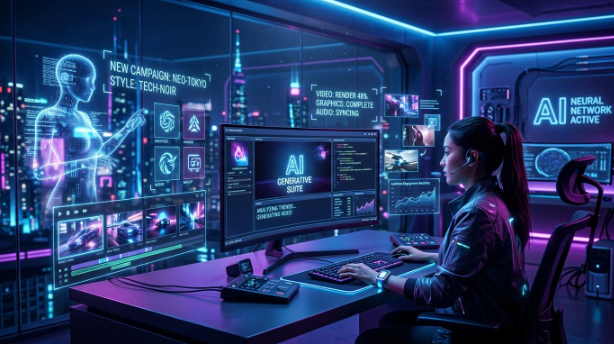
Artificial intelligence has moved far beyond being a futuristic concept. It is now becoming part of everyday digital work, from writing and graphic design to video production, marketing, education, and customer communication. As AI tools become easier to use, businesses and independent creators are finding new ways to produce content faster while maintaining a consistent digital presence.
One of the most visible changes is happening in video production. Creating a professional video traditionally required cameras, lighting, actors, editing software, and a considerable amount of time. Today, AI-powered platforms can assist with scripting, visual creation, voice generation, animation, subtitles, and editing. This does not mean traditional production will disappear, but it does give creators another practical option for producing content.
The Growing Role of AI in Video Creation
Video has become one of the most important formats on the internet. Businesses use it to explain products, educate customers, promote services, and communicate with their audiences. Social media platforms have also increased demand for short and engaging videos.
AI can simplify many parts of this process. A creator can start with a written idea and use different AI tools to develop a script, create visuals, generate narration, and prepare a final video. This can significantly reduce the amount of repetitive work involved in production.
The technology is particularly useful for businesses that need to create several versions of the same content. A company may want one video for its website, another for social media, and additional versions for different languages or audiences. AI can make these adaptations much easier.
The development of AI technology is also changing how people think about digital media. Instead of treating every video as a completely separate production, organizations can build reusable workflows that allow content to be created and modified more efficiently.
Digital Avatars Are Becoming More Practical
Another important development is the rise of digital avatars. AI-generated presenters can appear in training materials, product demonstrations, educational videos, and internal company communications.
For some organizations, this provides a practical alternative to arranging a new filming session every time information needs to be updated. A company can prepare a presentation, modify the script when necessary, and produce a new version without rebuilding the entire production process.
This approach can be useful for international organizations as well. A single presentation can potentially be adapted for different languages and markets while maintaining a consistent visual identity.
However, businesses should also consider transparency when using synthetic media. Audiences increasingly want to understand whether a person, voice, or image is real or generated. Clear communication about the use of AI can help organizations maintain trust.
Creativity and the Question of AI Restrictions
The rapid growth of generative AI has also created discussions about moderation and creative freedom. AI companies have to balance user creativity with concerns involving safety, privacy, copyright, and misuse.
This creates a complicated situation for professional creators. A legitimate creative request can sometimes be affected by automated safety systems that are designed to prevent harmful content. As a result, creators may need to understand the policies of the tools they use and adapt their workflows accordingly.
The discussion around AI moderation is becoming increasingly important as generative systems become more powerful. A recent article dédiée explores this broader debate around how AI systems are being restricted and what those restrictions can mean for creative work.
The issue is not simply about allowing or blocking content. It is about finding a reasonable balance between creative freedom and responsible technology development.
AI Is Changing the Economics of Content Production
The biggest impact of AI may ultimately be economic rather than technical. Producing high-quality content has traditionally required specialized professionals and expensive equipment. AI tools can lower some of those barriers.
A small business, for example, may not have the budget for a full production team. With AI-assisted tools, it can create product demonstrations, promotional videos, social media content, and educational materials with fewer resources.
This does not eliminate the need for human expertise. Someone still needs to understand the target audience, develop a meaningful message, review the output, and make creative decisions. AI can accelerate production, but strategy and judgment remain important.
The same principle applies to freelancers. Instead of spending hours on repetitive production tasks, creators can use AI to handle certain parts of the workflow and spend more time on creative direction, research, client communication, and quality control.
Human Creativity Still Matters
There is a common misconception that AI will completely replace human creativity. In practice, the relationship is more complicated.
AI systems can generate images, videos, text, music, and other forms of media, but they do not automatically understand the complete business context behind a project. Human creators decide what should be produced, who it is for, what message it should communicate, and whether the final result actually works.
The strongest workflows are therefore likely to combine machine assistance with human direction.
A designer can use AI to explore dozens of concepts before selecting one. A marketer can generate several versions of a campaign and then refine the strongest ideas. A video producer can automate repetitive editing tasks while focusing on storytelling.
This collaborative approach allows technology to become a creative assistant rather than simply a replacement for creative professionals.
What Comes Next?
AI development is moving quickly, and digital content production will continue to evolve. Video generation, digital avatars, automated editing, synthetic voices, and intelligent creative assistants are likely to become increasingly integrated into everyday workflows.
Businesses will need to learn how to use these tools responsibly. Creators will need to understand both their capabilities and limitations. Consumers will also become more familiar with identifying and evaluating AI-generated content.
The most important change may be that professional content production is becoming more accessible. People who previously lacked expensive equipment or technical skills can now experiment with formats that were once difficult to produce.
Artificial intelligence is not simply creating another generation of software tools. It is changing how digital content is imagined, produced, distributed, and updated. The technology will continue to improve, but the organizations and creators that combine it with strong ideas, human judgment, and responsible practices are likely to get the most practical value from it.