 By A Zadid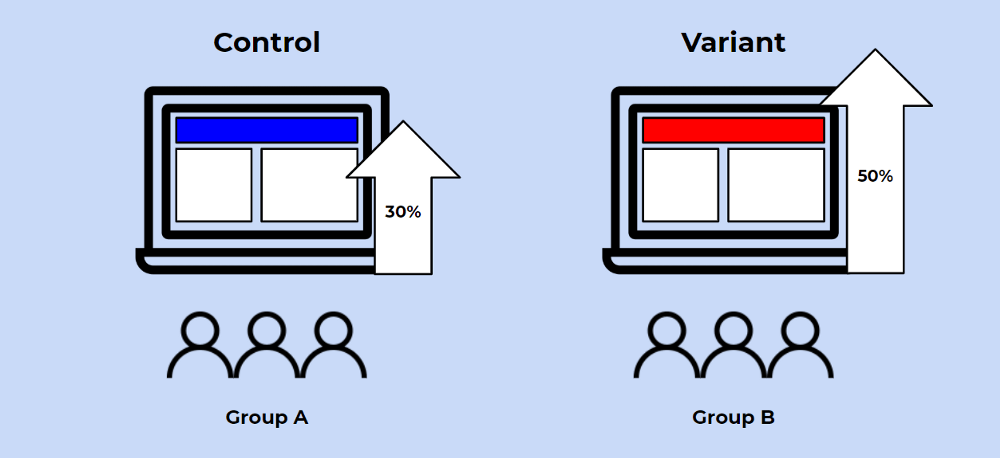
Introduction
A/B testing is one of the most practical ways to make business decisions with evidence instead of opinions. When organisations debate whether a new website layout will improve sign-ups or whether a revised pricing message will reduce drop-offs, the risk is not just getting it wrong. The bigger risk is rolling out a change across all users without knowing its impact. Experimentation in business analytics provides a controlled way to test changes, measure outcomes, and learn what actually drives results.
At its best, A/B testing is not a one-off activity run by a data team. It is a repeatable decision-making method that aligns product, marketing, and operations around measurable outcomes. When teams build experimentation into their routine, analytics becomes a tool for learning and optimisation, not just reporting.
What A/B Testing Measures and Why It Matters
A/B testing compares two versions of something, often called Variant A (the current version) and Variant B (the changed version). Users are randomly split into groups, each group sees one variant, and the business measures whether Variant B performs better on a chosen metric.
What makes this approach valuable
- Causal clarity: It helps answer whether the change caused the outcome, not just whether two things happened together.
- Reduced decision risk: Instead of full rollout based on assumptions, teams validate before scaling.
- Incremental improvement: Many small wins compound into significant long-term gains.
A/B testing is widely used in digital products, but the same logic applies to sales workflows, customer support scripts, onboarding sequences, and even internal operational processes. As long as outcomes can be measured and comparisons can be controlled, experimentation becomes possible.
Designing a Good Experiment
The strength of an A/B test depends on design discipline. Poorly designed tests can mislead teams into making decisions that do not hold up in real-world conditions.
Start with a clear hypothesis
A test should begin with a statement like: “If we simplify the checkout form, then the purchase completion rate will increase because users face less friction.” This forces clarity on what is changing, what outcome is expected, and why.
Choose one primary metric
Teams often fail by tracking too many “success” measures. Select one primary metric that reflects the goal, such as conversion rate, retention, revenue per user, or time-to-complete. Secondary metrics can be monitored for safety, such as error rate or refund rate.
Ensure randomisation and clean segmentation
Random assignment of users helps prevent bias. Segmentation matters too. If mobile and desktop users behave differently, test results may vary across segments. This is where business analytics becomes critical, ensuring tests are interpreted with context rather than averages.
Professionals building foundational experimentation skills often learn these design principles through a business analysis course in pune, where analytics is taught as a structured method for decision making rather than just dashboarding.
Interpreting Results Without Common Statistical Traps
A/B testing looks simple, but interpretation is where teams often go wrong. Many incorrect conclusions come from rushing decisions before results stabilise.
Avoid ending tests too early
If a team checks results every day and stops when Variant B looks better, the chance of a false positive increases. Tests should run long enough to collect sufficient sample size and cover typical behavioural cycles, such as weekday vs weekend patterns.
Watch for novelty effects
A short-term lift may occur simply because a change is new or more visually noticeable. A good test plan considers whether the benefit is durable, especially for UI and messaging experiments.
Understand practical significance
A result can be statistically significant but commercially irrelevant. For example, a 0.2% conversion improvement might not justify implementation cost or operational complexity. Business impact should always be part of interpretation.
Where Businesses Apply A/B Testing Beyond Websites
A/B testing is not limited to product teams. In business analytics, experimentation can support decisions across multiple functions:
Marketing and acquisition
- Testing ad creatives, landing pages, email subject lines, and call-to-action phrasing
- Comparing audience targeting strategies or campaign sequencing
Sales and customer success
- Testing discovery call scripts, follow-up timing, and proposal formats
- Evaluating onboarding flows that reduce early churn
Operations and process improvement
- Comparing workflow changes that reduce turnaround time
- Testing different approval structures or escalation paths
The key is to define measurable outcomes and ensure comparisons are fair. When organisations use experimentation as a habit, teams shift from arguing based on experience to learning based on data.
Building an Experimentation Culture
Tools alone do not create a strong experimentation practice. Culture does. A mature analytics-driven organisation treats tests as learning opportunities, even when the result is “no improvement.”
Practices that help
- Documented experiment logs: Capture hypothesis, design, metrics, timeline, and outcomes.
- Cross-functional review: Product, engineering, marketing, and analytics should agree on what “success” means before the test starts.
- Governance and ethics: Tests should respect user privacy, avoid manipulative design, and follow compliance guidelines.
Developing this mindset is often a focus area in a business analysis course in pune, where learners are trained to connect measurement with business decisions in a structured and responsible way.
Conclusion
A/B testing and experimentation are essential methods in business analytics because they replace guesswork with evidence. When designed well, experiments clarify what drives real outcomes, reduce the risk of costly rollouts, and create a repeatable improvement engine. The most valuable part of A/B testing is not the uplift itself, but the learning it creates. Over time, organisations that experiment consistently build stronger products, smarter processes, and more confident decision making driven by measurable results.